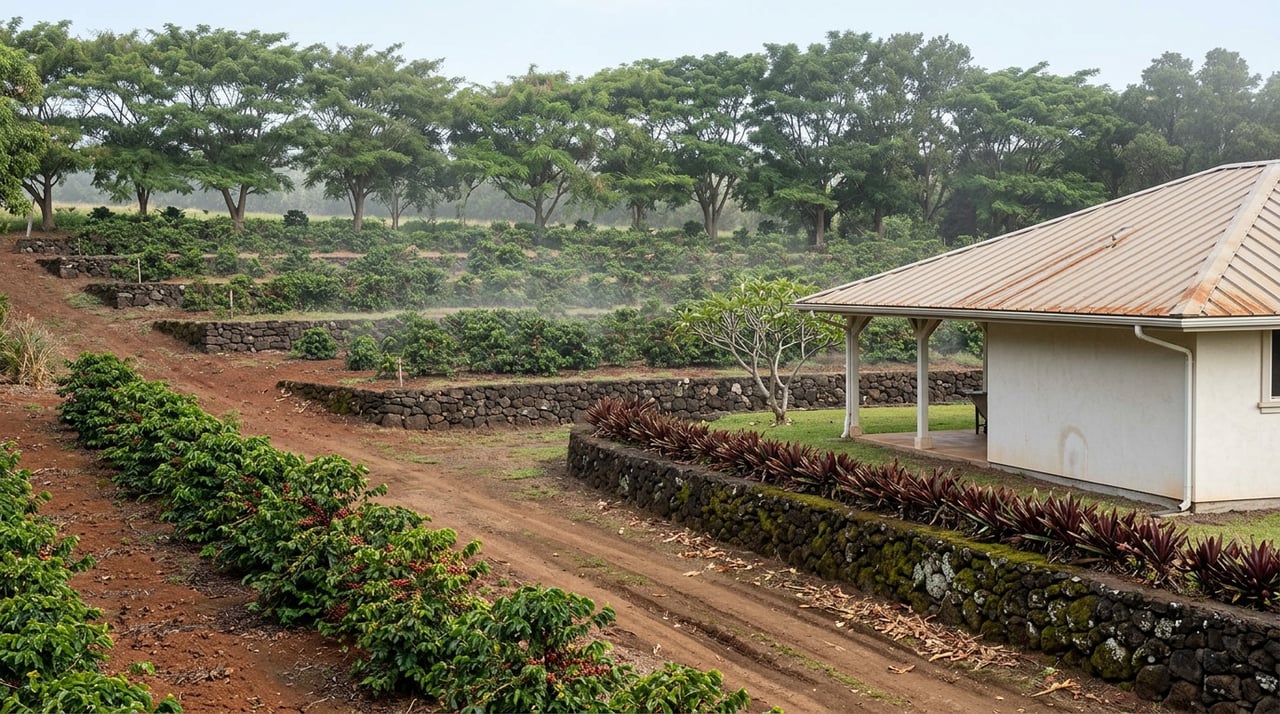
A buyer stands on a graded pad above Mamalahoa Highway, coffee trees running downhill in neat rows, ocean visible past the canopy. The listing agent mentions the tree count. The buyer nods, but does the math in his head anyway: acres times yield times price per pound. He is pricing a business. He should be pricing a view with landscaping attached.
That confusion is the whole story of buying a working coffee farm in Holualoa, and it costs people real money in one direction or the other. Some buyers pay a premium assuming the trees will cash-flow the mortgage. Some walk away from a genuinely good property because they ran the agricultural numbers and got scared. Both are making the same mistake: treating the coffee as the asset, when in most cases here it's closer to décor.
The price tag isn't set by the trees
Working coffee farms in the Holualoa belt, along with the neighboring Honaunau, Captain Cook, and Kealakekua coffee country, have been trading in roughly the $1 million to $3 million range for parcels between 3 and 15 acres, based on Hawaii Information Service MLS activity through May 2026. That is a wide band for properties that, on paper, produce the same crop.
What moves a farm from the bottom of that range to the top isn't tree density or last season's cherry yield. It's elevation within Holualoa's roughly 1,200 to 2,000 foot band, unobstructed ocean view, road frontage, and whether the buyer is getting a turnkey operation with a farm manager already in place versus bare acreage with legacy trees nobody has pruned in years. Two farms with identical production numbers can sell a million dollars apart because one has a paved driveway and a view corridor and the other doesn't.
That's worth sitting with before you tour a single property. If the number on the listing were tracking coffee income, the spread inside that $1M to $3M range would track yield data. It doesn't. It tracks the same variables that price a residential lot: position, view, access.
What the cherry actually pays
Here is the number that resets expectations fastest. Farmers who sell their harvest as raw cherry to a local wet mill, rather than processing and roasting it themselves, have historically received somewhere between $1.20 and $2 a pound. Suzanne Shriner, vice president of the Kona Coffee Farmers Association, put it bluntly in an interview a few years back:
"When you sell cherry, you can get $2, if you're lucky."
Compare that to what a pound of finished, roasted, 100% Kona coffee sells for once a farm processes it themselves and sells direct: commonly $27 to $35 a pound, sometimes higher depending on grade and brand.
| Path to market | Approximate price per pound |
|---|---|
| Sell raw cherry to a wet mill | $1.20 to $2.00 |
| Process and sell direct as roasted coffee | $27 to $35+ |
That gap is not a rounding error. It is the entire difference between a coffee farm that loses money and one that doesn't. A University of Hawaii economic analysis of the state's coffee sector, published through the National Library of Medicine, notes that most Hawaii coffee farms are small operations under 5 acres with annual sales between $10,000 and $250,000, and that while most commercial farms are profitable overall, some smaller "lifestyle farms" run a low output to input ratio with negative net profits. Translation from the research literature into plain terms: if you buy the land, keep the trees, and sell cherry to a mill without doing anything else, you are very likely subsidizing a hobby, not running a business.
The borer tax that never goes away
Part of why the cherry-only math is so thin traces back to 2010, when the coffee berry borer was first identified in South Kona. Before the pest arrived, farmers describe getting roughly 5 pounds of cherry for every pound of sellable Grade A coffee. After it took hold across the district, that ratio slid toward 7 to 1, which effectively doubles the harvesting cost per pound of usable coffee even when the price paid per pound stays flat.
The borer hasn't been solved. It's been managed, continuously, at a cost. The Kona Coffee Farmers Association's own 2026 grower guidance still walks members through integrated pest management: Beauveria bassiana fungal sprays, sanitation, strip-picking infested trees. Earlier this year, the association was actively lobbying the state legislature in support of HB2119, a bill to reestablish a coffee berry borer and coffee leaf rust pesticide subsidy program, because the ongoing cost of controlling these pests is still significant enough to need policy help. If you buy a farm here, you are buying into that maintenance obligation whether or not the seller mentions it during the walkthrough.
Labor is the line item the listing doesn't show
Kona coffee is still hand-picked, because only hand-picking allows selective harvesting of ripe cherry, and that selectivity is what makes 100% Kona coffee taste like 100% Kona coffee rather than a mixed-ripeness commodity crop. As of 2025, farm labor for that hand-picking has been running $25 to $30 an hour in the region, well above what mechanized coffee operations pay elsewhere in the world.
None of that appears on a real estate listing sheet. It shows up the first September you try to bring in a harvest and discover that the going wage for pickers who know what they're doing has moved since the seller last budgeted for it.
Where the math does work
This isn't an argument against buying a coffee farm in Holualoa. It's an argument for knowing which farm you're buying. The economics genuinely work for owners who process their own crop, control quality closely enough to sell direct at retail or wholesale-to-roaster prices, and treat the farm as a working business with a marketing plan, not a passive asset that happens to have trees on it. Coffee remains one of the state's significant agricultural commodities, and Hawaii is one of the only places in the country where a grower can choose exactly how far down the supply chain to take their own product, selling as cherry, parchment, green bean, or finished roast, depending on what infrastructure and time they have.
The buyers who get burned are the ones who assume the farm will run itself and pay for itself on cherry sales alone. The buyers who do well are the ones who go in with a plan for the last mile: processing, branding, and a direct sales channel, or a clear-eyed decision to keep the trees purely as landscape and buy accordingly.
What this means if you're comparing neighborhoods
If you're weighing Holualoa against inland or coastal alternatives in West Hawai'i, the coffee farm question is really two separate decisions wearing one price tag. The first is whether you want the upcountry lifestyle: the elevation, the working village character, the cooler air. The second is whether you actually want to operate an agricultural business, with its own labor market, pest management calendar, and legislative dependencies like HB2119. You can buy into the first without the second. Plenty of Holualoa owners keep a farm manager or lease the trees out and treat the acreage as a scenic buffer. That's a legitimate way to own here. Just budget the purchase like you're buying land and a lifestyle, not like you're buying a coffee company, unless you're prepared to actually run one.
A few questions worth asking before you make an offer
Do I have to keep the property as a working coffee farm? No. Ag-zoned land in Holualoa carries obligations around use and subdivision, but nothing requires an owner to actively farm at scale. Many owners maintain the trees at a reduced level or lease the agricultural operation to a third party.
What should I ask to see before buying a farm marketed as "producing" or "turnkey"? Ask for at least two to three seasons of actual harvest and sale records, not projected yield. Ask whether cherry was sold to a mill or processed in-house, since that single fact changes the real revenue picture more than any other detail.
Is the Kona coffee industry actually shrinking? The data doesn't point that way. The Kona Coffee Farmers Association remains active in state policy, its leadership has recently taken on a formal role in state agricultural governance, and coffee remains one of Hawaii's higher-value specialty crops. The challenges are real, but they're the kind an established, organized industry manages rather than the kind that signals decline.
If you're looking at coffee-belt acreage in Holualoa and want to separate the view premium from the working farm economics before you write an offer, Team Kuessner Davis can walk the numbers with you property by property. Schedule a consultation and we'll help you figure out exactly what you'd be buying.