Why would an invasive beetle problem that started at the airport, more than a mile downhill, suddenly become a Kona Palisades problem specifically? Not Kailua-Kona town. Not Kaloko. Kona Palisades, by name, singled out in state meetings and county press releases as the next likely address for an infestation that has already cost Hawaii Island's coconut palms real damage.
The answer has nothing to do with luck and everything to do with geography. If you live along Kaʻiminani Drive, the flight path of a beetle most residents have never seen runs directly under your address, and that fact has already changed how the county treats your yard waste this year.
The Ground Zero a Mile and a Half Downhill
Franny Kinslow Brewer, program manager for the Big Island Invasive Species Committee, has a specific answer for why Kona Palisades keeps coming up in coconut rhinoceros beetle briefings. Last July, an on-site inspection of Keahole Agricultural Park by multiple agencies uncovered two active breeding sites inside a landscape nursery. Investigators found 110 late-stage larvae and three adult beetles at that single location. Since then, officials have documented an average of roughly 20 adult beetles a month in the surrounding area, along with varying larval counts.
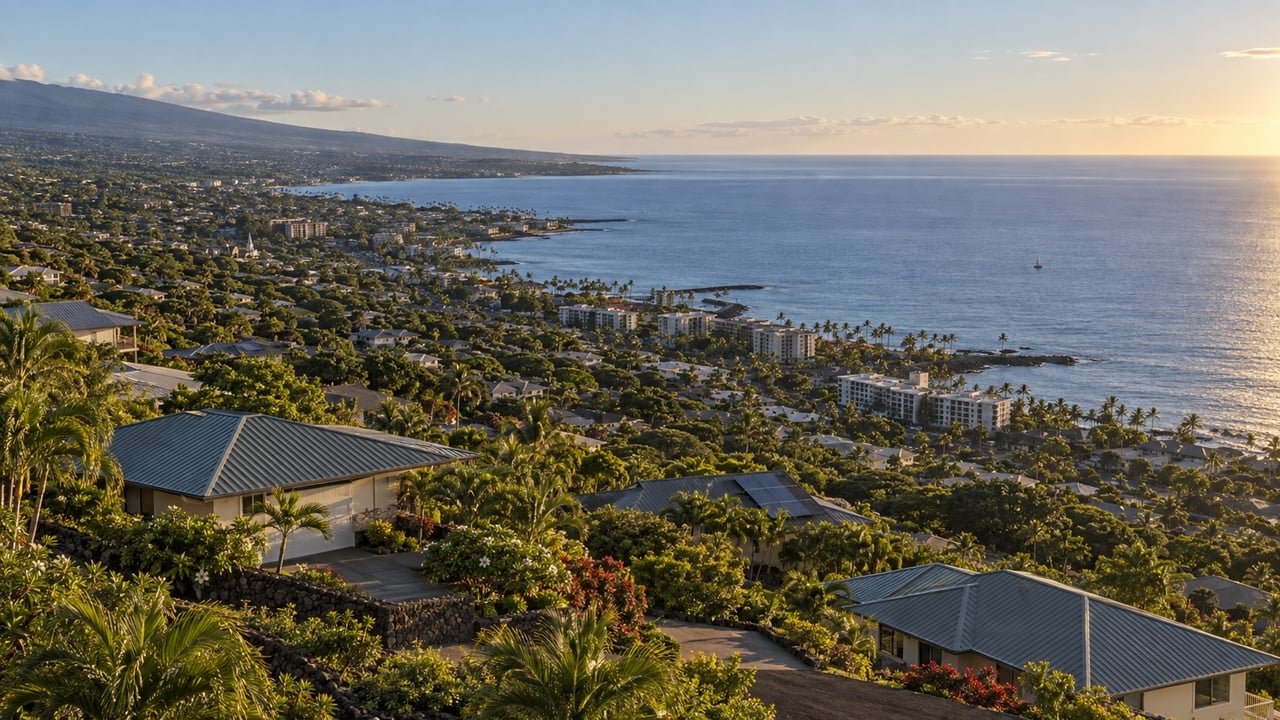
Keahole Agricultural Park sits close to sea level, right at the base of Kaʻiminani Drive. Kona Palisades sits above it, climbing from near sea level to about 1,500 feet at Māmalahoa Highway. That elevation difference is the whole story.
"That's ground zero, right there at the base of Kaiminani Drive. That's where this infestation has been radiating out from, so what this is based on is really that location being right up the mountain, basically, directly above the area where we know the beetles are breeding and they are flying uphill."
Brewer made that point to the Tribune-Herald in June, and it's the reason Kona Palisades shows up in state agriculture meetings ahead of neighborhoods with far more coconut palms. The beetles aren't spreading randomly across West Hawaii. They're moving up the same slope your commute follows every morning.
What Changed on the Ground This Year
The regulatory response escalated in stages, and each stage left a mark on Kona Palisades specifically.
| When | What happened |
|---|---|
| March 2025 | Live coconut rhinoceros beetles first trapped near Kona International Airport |
| March 24, 2026 | State Board of Agriculture and Biosecurity approves Interim Rule 26-1, restricting movement of beetle host materials like mulch and compost within the designated infested area |
| Late April to May 4, 2026 | Curbside green waste collection runs along Kaʻiminani Drive between Māmalahoa Highway and Queen Kaʻahumanu Highway |
| June 26 to 27, 2026 | Multi-agency drop-off effort at Lokahi Makai Park, the first time BIISC, Hawaiʻi Wildfire Management Organization, Hawaiʻi Department of Transportation, and the Department of Land and Natural Resources coordinated a single neighborhood-scale push |
| July 29, 2026 | State officially expands the CRB containment zone that already stretched from downtown Kailua-Kona to Waikoloa |
| September 19 to 25, 2026 | Hawaiʻi DOT lane closures scheduled for vegetation cutting near Kaʻiminani Drive and Kaʻiwi Street |
That last line matters if you're reading this in September. The county is still out there this week, cutting vegetation along the same corridor Brewer flagged as the beetle's likely uphill route. This isn't a problem that got handled in the spring and quietly closed out. It's still active.
Interim Rule 26-1 also means something practical for anyone doing landscaping work. If a business is moving mulch, compost, or potted plants out of the containment zone, it now needs a permit from the state agriculture department. BIISC has been training commercial operators on how to comply, though the Hawaiʻi County Council pushed the state in July to speed up enforcement, saying the agriculture department had been slow communicating the new rules to businesses that actually need them.
The Experiment Nobody's Run Before
Here's the part that separates this year's approach from a routine yard waste drive. When asked whether pulling green waste out of Kona Palisades yards would actually slow the beetle's advance, Brewer was candid.
"We don't know. No one's done it before."
That's not a hedge. It's an accurate description of where the science stands. Composting and mulch production have been encouraged on Hawaii Island for years as good land stewardship. The beetle changes that calculation, because the same decaying plant matter that makes good mulch also makes ideal breeding material for a female CRB looking to lay eggs. The June collection effort at Lokahi Makai Park was the first attempt anywhere to test whether removing that material at a neighborhood scale, rather than yard by yard, actually slows an active infestation before it establishes. Collected material was fumigated, ground, and heat-treated before being reused as mulch, specifically to kill any beetles, larvae, or eggs riding along inside it.
If you put your green waste out during that collection, or the curbside run before it, you weren't just tidying up. You were part of the only real-world test of whether this tactic works.
What This Actually Means for a Kona Palisades Yard
None of this requires panic. It requires knowing what to look for and where the lines are drawn.
- The affected corridor runs along Kaʻiminani Drive between Māmalahoa Highway and Queen Kaʻahumanu Highway, the same stretch under DOT vegetation work this week.
- Adult beetles are black with brown fuzz, roughly 1.5 to 2 inches long, with a single distinctive horn. They're nocturnal, so you're far more likely to spot larvae than adults.
- Larvae are off-white grubs with a brownish head, found in compost, mulch piles, and decaying stumps rather than out in the open.
- Green waste piles left sitting on a property serve double duty as fire fuel and beetle breeding ground, which is why HWMO joined this effort alongside BIISC.
- An October 2025 helicopter survey of the Kona Palisades area, run jointly with the University of Hawaiʻi at Hilo's Spatial Data and Visualization Lab, found green waste piles concentrated in open or undeveloped parcels away from private homes and roads, meaning vacant lots in the neighborhood carry some of this risk too.
- Report sightings, damaged palms, or suspicious piles to BIISC directly by emailing [email protected] or calling or texting 808-731-9232.
There's one detail Brewer has pointed to that actually works in the neighborhood's favor. Comparing Kona to a beetle detection later found in Hilo, she noted that on the Kona side, decomposing organic material tends to sit visibly on lava rock rather than hidden among wild, unmanaged trees. In practice, that means a green waste pile in Kona Palisades is usually easier to spot and clear than the equivalent problem would be almost anywhere else on the island. The uphill math put this neighborhood on the list first. The exposed terrain is part of why it also has a real shot at getting ahead of it.
If you've spent the last few months wondering why county trucks keep showing up along Kaʻiminani Drive, or why the neighborhood board meeting agenda mentioned beetles instead of the usual road repair updates, this is the reason. It's not a bureaucratic footnote. It's a live containment effort happening in the yards around you, running an experiment that hasn't been tried anywhere else, on a timeline that started with a nursery inspection at the bottom of the hill and hasn't finished yet.
We track this kind of hyperlocal development because it's part of understanding a neighborhood well, not just its home values. If you have questions about how any of this touches a specific property in Kona Palisades or elsewhere in North Kona, Team Kuessner Davis is happy to talk it through. Schedule a Consultation whenever it's useful.