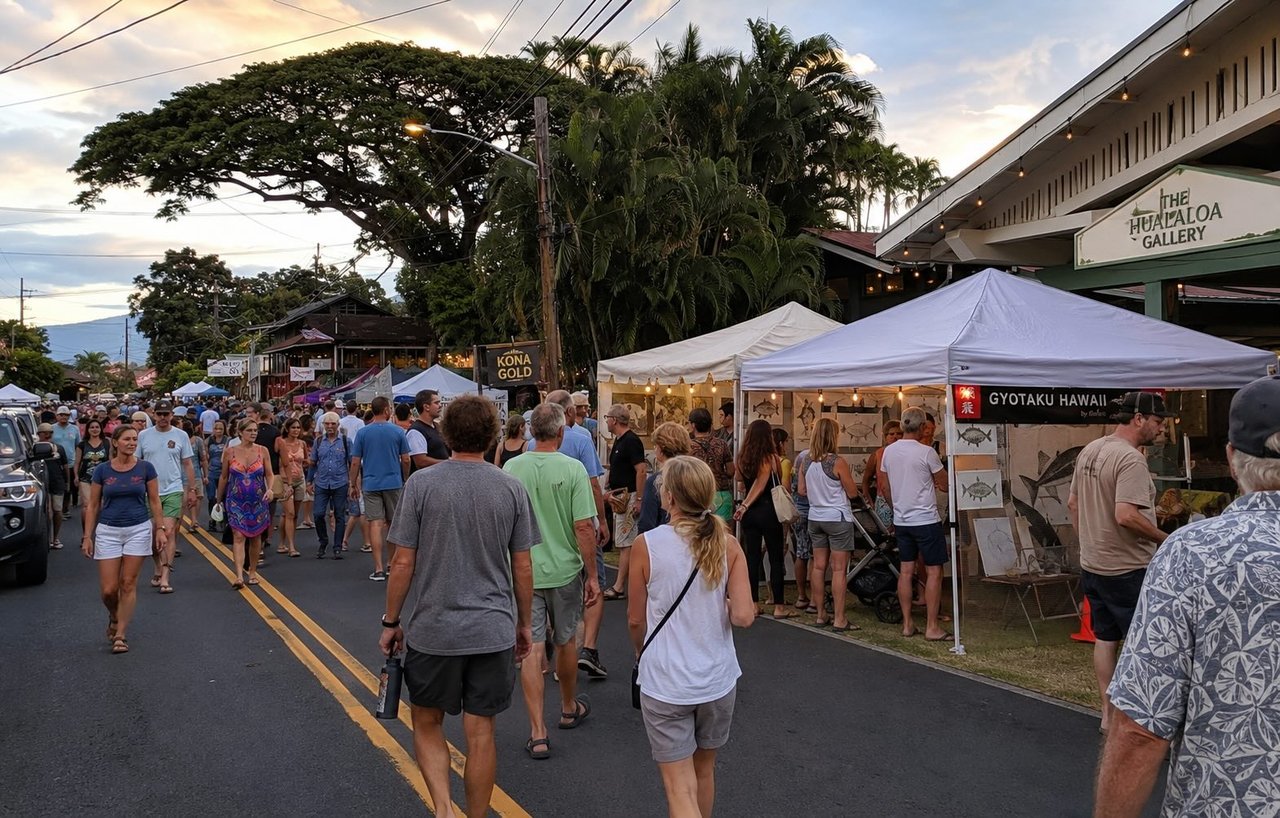
Friday mornings I drive up Hualalai Road to the Imin Center for Tai Chi. Five days a week, my dog and I are at Central Bark, the small and medium dog yard up Mamalahoa Highway. The first Friday of every month I am back in Holualoa Village for the Stroll. Once a year I am there for the Coffee and Art Stroll during the Kona Coffee Cultural Festival, and again in December for the Light Up Holualoa Music and Light Festival. I do not live in Holualoa Village. I drive there, a lot, because what is happening in this small artist town above coastal Kona is, for a certain kind of buyer, the entire reason to live on the Big Island.
Holualoa is the higher-elevation, smaller-scale alternative to coastal Kailua-Kona. The village sits around 1,500 feet up the western flank of Hualalai. Days are roughly six to ten degrees cooler than the coast, the air is cleaner, the evening light is softer, and the community is real. The trade is honest and worth saying up front. From Holualoa, every errand is a drive. We will get to that. The point of this post is to help a buyer who is comparing Holualoa to lower-elevation Kona decide whether you are an elevation buyer or a coast buyer.
Key Takeaways
- Holualoa Village sits at roughly 1,500 feet of elevation. Daytime temperatures run six to ten degrees cooler than coastal Kailua-Kona, and winter nights can drop into the mid-50s.
- The drive from Holualoa Village down to downtown Kailua-Kona is about 15 minutes on Hualalai Road in normal traffic. Every errand is a drive. That is the central trade-off.
- Holualoa has a real, year-round community calendar: the First Friday Stroll every month, the Holualoa Village Coffee and Art Stroll during the Kona Coffee Cultural Festival each November, and the Music and Light Festival in December.
- The Holualoa zone is bigger than the village. It runs from the village down through the Kona coffee belt and includes upper subdivisions. Climate, price, and what you can grow on the land change with every few hundred feet of elevation.
- Holualoa works for buyers who want elevation, character, and community. It does not work for buyers who need to be five minutes from the water or the grocery store.
What Holualoa Actually Is
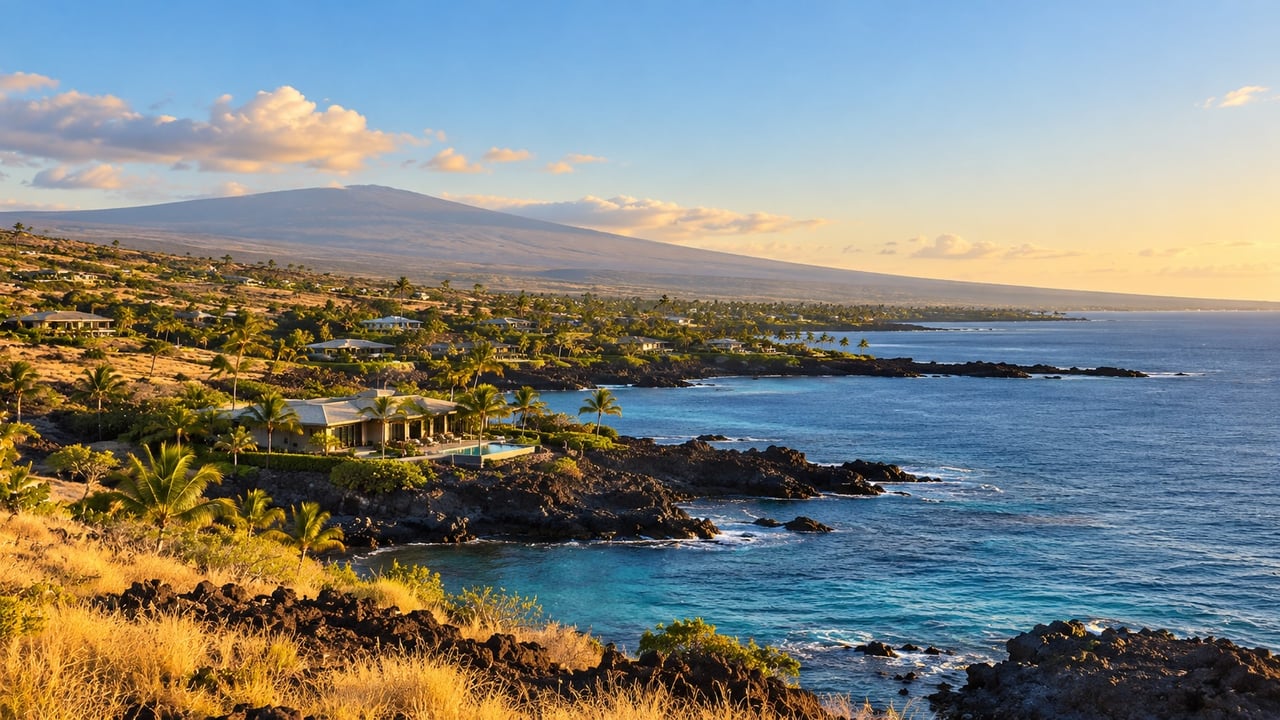
Holualoa is a small historic village strung along Mamalahoa Highway (Highway 180) above coastal Kona. The village proper is about a mile of two-lane road lined with art galleries, coffee shops, the historic Kona Hotel, the Holualoa Inn, the Imin Center, and a handful of restaurants and small businesses. From the village you can see the coast laid out below you and the mountain rising behind.
The Holualoa zone, though, is bigger than the village. It runs north and south along Mamalahoa Highway through the heart of the Kona coffee belt, the band of mountainside between roughly 800 and 2,500 feet of elevation where Kona coffee is grown. South of the village you are in the upper coffee belt with farms tucked into the hillside. North of the village you climb into older subdivisions and larger lots.
We say "Holualoa" to cover all of this, but a buyer needs to understand what they are actually looking at. A two-acre coffee farm at 1,400 feet is a different property than a quarter-acre village home half a mile away, and both are different from a five-acre upper subdivision lot at 2,000 feet with no coffee on it. Brenda has been selling Holualoa property for 35 years, and the most common mistake we see mainland buyers make is assuming "Holualoa" means one thing. It does not.
The Climate Difference: 1,500 Feet Changes Everything
The single biggest reason people buy in Holualoa is the climate. Coastal Kailua-Kona has a hot, semi-arid climate. The airport area gets less than 20 inches of rain a year, and summer days run consistently in the mid-80s. Holualoa, 1,500 feet up the same mountain, gets noticeably more rain, noticeably cooler days, and meaningfully cooler nights. A useful comparison we have actually measured: 84 degrees on the coast and 78 degrees in Holualoa at the same hour on the same afternoon. In winter, nights in Holualoa can drop into the mid-50s. Coastal nights stay in the upper 60s.
That six to ten degree daytime difference and the cooler nights are why some longtime Kona residents will not live below 1,000 feet. Houses in Holualoa typically do not need air conditioning. Ceiling fans and trade winds do the work. You sleep with the windows open and wear a light layer in the evening. The right mainland comparison is not Florida or Phoenix. It is closer to coastal central California or parts of the Mediterranean. Think Santa Barbara up the hill, not Honolulu. Holualoa is green. Coastal Kona is dry with imported landscaping. If you have visited Kona only on the resort coast and thought "this is dry," drive up Hualalai Road for fifteen minutes and see what the same island looks like at elevation.
The Honest Downside: Every Errand Is a Drive
The drive from Holualoa Village to downtown Kailua-Kona is about 15 minutes on Hualalai Road in normal traffic. Kona International Airport is roughly 25 minutes. Costco and the hospital are about 20.
For most weeks that is fine, but the cumulative effect of every errand being a drive does shape how you live. You batch trips. You plan the day around going down once. After dinner downtown you are driving home in the dark on a winding two-lane road with no streetlights. Some buyers love that. Some decide they want to be closer to where things happen. We have helped clients on both sides of that line, and the drive is worth weighing honestly before you buy.
The Community That Mainland Buyers Miss
The other thing that surprises mainland buyers about Holualoa is that there is a real community calendar. This is not a sleepy village that wakes up for tourists. It is a small town with a rhythm.
The First Friday Stroll happens the first Friday of every month, rain or shine. Galleries stay open into the evening, there is live music, food, and the village turns into something between a block party and a gallery night. I am there most months. The art is genuinely good. The Donkey Mill Art Center, the Holualoa Foundation for Arts and Culture, and a long list of working artists and galleries make this a real artist town, not a theme-park version of one.
In November, Holualoa hosts the Holualoa Village Coffee and Art Stroll as part of the Kona Coffee Cultural Festival. Coffee farmers come down off the mountain, set up in front of the galleries, pour samples, and talk about the harvest. Each gallery features coffee-themed work. If you are thinking about buying coffee land, it is the single best place on earth to taste twenty Kona coffees back to back and figure out which farms you actually like.
In December, the Light Up Holualoa Music and Light Festival turns the village into something out of a holiday card. The town tree gets lit, Santa shows up, and the historic buildings glow with light installations. Galleries serve free pupus and stay open late. Music spills out of every doorway. We go every year.
Two other things, both small and both load-bearing. Five days a week, my dog and I are at Central Bark on Mamalahoa Highway, the dog park run by the Hawaii Island Humane Society with separate fenced yards for smaller and larger dogs, double-gated entries, shade, and a regular crew of locals. If you have a dog and you are moving to the Big Island, this matters more than you think. And every Friday morning I do Tai Chi at the Imin Center in the village, a Hawaii County facility on the site of the old Japanese language school that serves as the Holualoa senior center and community gathering space. The regular classes there are exactly the kind of low-key, reliable programming that makes a place feel like a place. Mainland buyers who never expected any of this are usually the ones who, eighteen months in, tell us they cannot believe how integrated they got.
What You Get for Your Money
Holualoa pricing is wider than almost any other zone on the West Side, because the area genuinely contains very different kinds of property. A small village home on a small lot is one thing. A multi-acre working coffee farm with a residence is another. A larger upper subdivision lot with views and no coffee is a third. Resort-finish estate homes on three or four acres at the right elevation are a fourth.
Luxury and acreage transactions pull the average sale price well above the median, so quoting a single number is not useful. Our advice is the same as everywhere else on the island. Ignore averages. Look at the specific kind of property you actually want. Brenda and I will pull current comps for the exact band of Holualoa you are considering, including coffee-producing acreage if that is the goal, and walk you through what each price point actually buys you in 2026.
A practical note on coffee land. A working Kona coffee farm is a real agricultural property, not a yard. There is harvest, processing, and tax considerations including general excise tax on wholesale sales. Some buyers lease the operation to a neighbor. Some run the farm themselves. The two paths look very different financially, and Brenda's depth on Kona coffee land is one of the reasons people send their friends to her.
Who Holualoa Works For, and Who It Does Not
Holualoa works for retirees who want community, not a resort. It works for work-from-home professionals who can absorb the drive because they are not driving down every day. It works for artists, writers, and people who want to be plugged into a creative scene. It works for buyers who want elevation, cooler nights, and a real garden, and who would rather know their neighbors than swim laps in a shared pool.
Holualoa does not work for buyers who need to be five minutes from the ocean, or who want a resort lifestyle with concierge, golf on property, and a gate, or who hate driving winding two-lane roads in the dark. None of these are problems with Holualoa. They are reasons a buyer might be a better fit on the coast or in a different zone like Keauhou or the Kohala Coast resort communities.
The simplest test is to come up for a Friday Stroll. If you walk the village, get a coffee, talk to a gallery owner, watch the light go gold over the coast, and feel like you want to come back next month, you are an elevation buyer. If you spend the evening checking how long the drive home is, you are probably a coast buyer. Both are correct. Knowing which one you are saves a lot of money and a lot of time.
Frequently Asked Questions
Is Holualoa cooler than Kailua-Kona, and by how much?
Yes. Holualoa Village sits around 1,500 feet of elevation, and daytime temperatures typically run six to ten degrees cooler than coastal Kailua-Kona. Winter nights in Holualoa can drop into the mid-50s, while coastal nights generally stay in the upper 60s. Houses in Holualoa typically do not need air conditioning, where coastal homes often do.
How long is the drive from Holualoa to Kailua-Kona, the airport, and Costco?
About 15 minutes from Holualoa Village to downtown Kailua-Kona on Hualalai Road in normal traffic. Kona International Airport is roughly 25 minutes. Costco and the hospital are about 20. Add time for afternoon stack-up on Hualalai Road or weekend congestion at the Costco end.
Are there grocery stores in Holualoa Village?
Not in the way you mean. The village has small shops, coffee shops, and restaurants, but for a full grocery run you are driving down to Kailua-Kona. Most residents do a weekly run and supplement with farmers markets and farm stands. If a five-minute drive to the grocery is non-negotiable, Holualoa is not the right neighborhood.
What is the First Friday Stroll in Holualoa?
A monthly evening event on the first Friday of every month, rain or shine. Galleries stay open late, there is live music and food, and the village turns into a relaxed block party. It is the easiest way to get a real feel for the place if you are thinking about buying here.
Can you buy a working coffee farm in Holualoa?
Yes. The Kona coffee belt runs through the Holualoa zone, and there are working farms for sale most years at a range of acreages. A working farm is an agricultural property with operating costs, harvest logistics, and tax considerations including general excise tax on wholesale sales. Some buyers want the land but lease the coffee operation to a neighbor. Some run the farm themselves. We help clients on both paths.
Is Holualoa a good place for retirees?
For the right retiree, yes. Buyers who want community, a milder climate, walkable village events, and a slower pace tend to do well here. Buyers who need to be close to medical specialists, who want resort amenities on property, or who do not want to drive at night may prefer coastal Kailua-Kona or Keauhou. The Imin Center hosts senior programming, including Tai Chi, which a lot of new residents plug into.
Holualoa is one of those places that does not photograph as well as it lives. So if you are choosing a Big Island neighborhood from a search bar on the mainland, it is easy to miss. That is part of why the people who do find it tend to stay.
If you are evaluating Kona and weighing elevation against the coast, the best thing you can do is come up here for a long weekend. Drive Hualalai Road. Walk the village. Time your trip around a First Friday or, if you can, the Coffee and Art Stroll in November or Light Up Holualoa in December. Brenda and I are happy to meet you for coffee, drive you through the different bands of the zone, and tell you straight which kind of buyer you are. The right neighborhood is the one that fits how you actually want to spend a Tuesday afternoon. Reach out any time.
Mark Davis, Esq. is a licensed real estate broker (RB-23769) with Kona Homes for Sale at Coldwell Banker Island Properties, Kailua-Kona, Hawaii. He practiced as a transactional and litigation real estate attorney for 35 years before moving to the Big Island full time. He currently serves as a member of the Hawaii County Real Property Tax Board of Appeal. Brenda Kuessner holds the ABR, CRS, e-PRO, GRI, and GREEN designations and has sold real estate on the Big Island for 35 years. Together they serve buyers and sellers across the Kona and Kohala Coast market. This post is for general informational purposes only and does not constitute legal or tax advice.