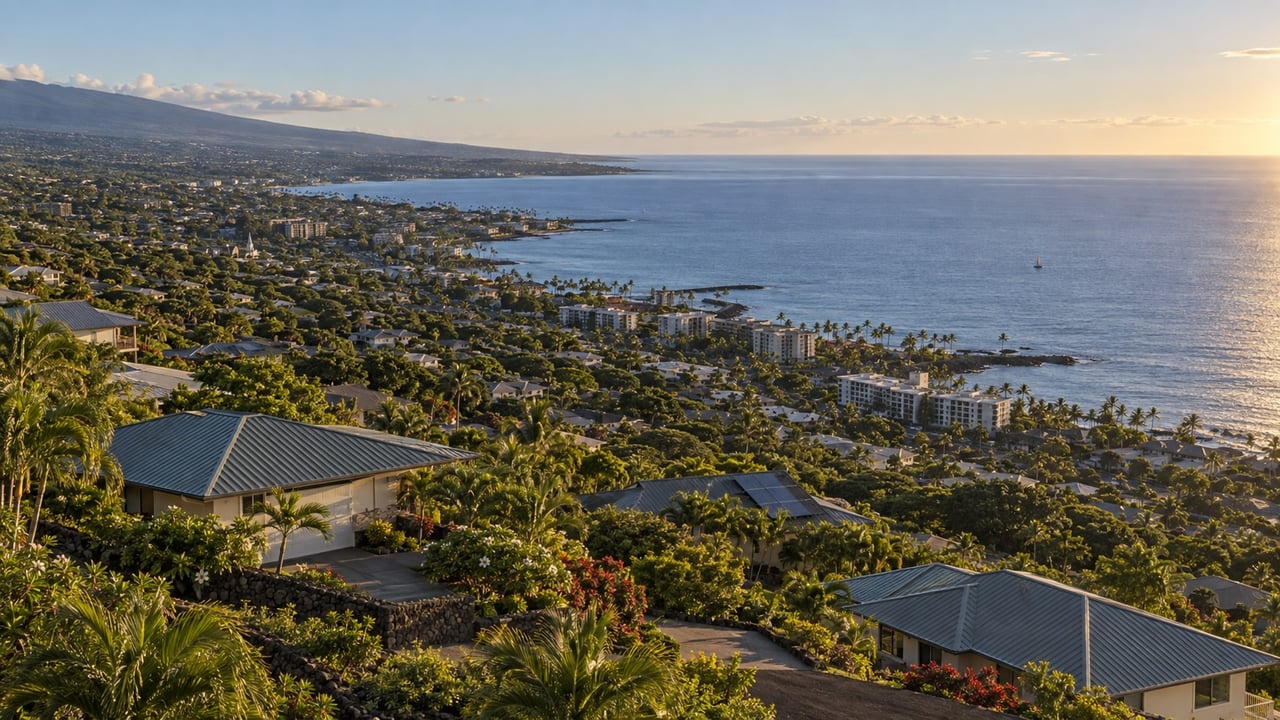
Picture two homes a few driveways apart in the same Kalaoa subdivision. Same elevation, same coastline view, same rough price bracket. One buyer closes in thirty days with a conventional loan. The other spends six extra weeks chasing a portable water storage estimate, a specialty insurance quote, and a lender who wants documentation nobody thought to ask for at the open house. The difference isn't the roofline or the lot size. It's whether the parcel sits on county water or catchment, and until recently there was no easy way to find out before you fell for the view.
That's the fact the median price for Kalaoa can't tell you, because at the parcel level, Kalaoa isn't one market. It's two, running side by side, and the boundary between them isn't marked on any listing photo.
Why the Same Street Can Have Two Different Water Realities
Kalaoa sits on the lower western slopes of Hualalai, in the band of North Kona uplands where the county's water lines don't reach every parcel. The area was built out in phases, agricultural subdivisions next to newer residential tracts, and county water infrastructure followed the development pattern rather than the other way around. That's why some homes on Kalaoa's upper slopes draw from a county meter and others rely on a rainwater catchment tank and roof system that the owner maintains entirely on their own.
The County of Hawai'i Department of Water Supply, the semi-autonomous agency that has run the island's domestic water service since 1949, operates 23 separate water systems across the Big Island. Kalaoa isn't served by one of them alone. County conservation and restriction notices from the department routinely group Kalaoa in with Kona Palisades, Kaloko, Kaloko Mauka, Honokōhau, Keahuolū, Keōpū, Hōlualoa, Waiʻaha, and Keauhou as a single shared North Kona system, which tells you two things: the infrastructure is interconnected across a wide upland corridor, and a hiccup anywhere in that system can touch Kalaoa specifically. It also means "county water availability" isn't a neighborhood-wide guarantee. It's parcel by parcel.
The Boundary Problem Nobody Mentions
Here's a wrinkle that explains why generic "Kalaoa market" numbers run thin if you go looking for them. Kalaoa was its own census-designated place through the 2010 count, with a population of 9,644 that year. By the 2020 Census, the area that used to be Kalaoa CDP had been absorbed into the Kaiminani CDP. The place still has a name people use, real estate professionals use it, county water notices use it, but the federal data that most market reports lean on doesn't isolate it anymore.
That matters for a buyer doing homework online. When you can't get a clean, isolated dataset for a neighborhood, the temptation is to fall back on the surrounding Kailua-Kona area numbers instead, and those numbers, while directionally useful, average over exactly the kind of infrastructure gap that makes one Kalaoa parcel a fast, financeable purchase and another a slower, cash-heavy one.
What Changes When a Home Runs on Catchment
None of this makes catchment a dealbreaker. Plenty of Kona-area buyers choose it deliberately and manage it well. But it does change the mechanics of a purchase in ways worth knowing before you write an offer rather than during your inspection period:
- Financing. Conventional lenders often want documented, reliable potable water. A catchment system with adequate storage and filtration can qualify, but it typically requires more paperwork and sometimes a specialized appraisal condition than a straightforward county-water hookup.
- Insurance. Carriers evaluating a rural water system will usually ask about tank capacity, filtration, and maintenance history. That's a conversation you want to have early, not the week before closing.
- Ongoing cost and attention. County water is a monthly bill and not much else. Catchment means gutters, tank inspections, filtration replacement, and watching your storage levels during dry stretches, on top of whatever the mortgage costs.
- Resale. A future buyer will ask the same water questions you're asking now. Documentation of your system's condition and any recent tank work becomes part of your listing story, not an afterthought.
The Hawaii Purchase Contract's standard inspection period exists in part to surface exactly this kind of thing. On a rural Kalaoa parcel, that window is where the condition of a catchment or well system gets evaluated, not assumed.
The Map That Didn't Exist Last Year
Here's what's actually new, and it's the reason this is worth writing about now rather than treating it as a general Kona truism. In September 2025, the county's Department of Water Supply rolled out a public, parcel-level GIS tool built under Resolution 137-25. A buyer or agent can search by tax map key or street address and see general water availability, any active water commitments tied to a specific parcel, and developer agreements covering wells or other infrastructure. Before that tool existed, this information lived scattered across department records and word of mouth. Now it's searchable before you ever make an offer.
That's a meaningful shift for anyone shopping the Kalaoa uplands. It means the question "does this parcel have county water or not" no longer has to wait until an inspection contingency. You can check it the same afternoon you tour the property, which changes how you should be pricing your comparisons from the start.
Reading the Water Question Against Today's Market
This detail lands differently depending on the broader market conditions, and 2026 has handed Kona buyers more room to ask it. Across Kailua-Kona, the single-family median sat at $1.225 million year-to-date through the first half of 2026, down 6.1% from the same period a year earlier, while months of supply climbed to roughly 5.4, generally read as a balanced market rather than a seller's market. The condo side corrected further, with a year-to-date median near $570,000, down about 12.3% year over year and back to levels last seen in 2023 after peaking near $694,000 in April 2025. Mortgage rates were sitting at 6.47% as of mid-June 2026.
None of those figures are Kalaoa-specific, for the reasons already covered. But the shift they describe, more inventory, longer time to sell, buyers with more negotiating room, means a Kalaoa shopper today isn't under the same pressure to skip due diligence that buyers faced during the tightest years of this market. If a listing's water source is unclear, you have the standing to ask, to check the county's tool, and to walk if the answer doesn't match your financing plan.
What This Means If You're Looking at Kalaoa Right Now
Treat the water question as seriously as you'd treat square footage or lot line. Before you get attached to a specific property, run the tax map key through the county's water availability search. Ask directly whether the parcel carries an active county water commitment or whether it's catchment, and if it's catchment, ask for tank age, capacity, and any recent service records. Bring that information to your lender early, since a catchment system can change what documentation they need before they'll issue a commitment letter.
This is the kind of parcel-level groundwork that a broker with legal and transactional depth is built for, tracing water commitments, reading the fine print on developer agreements, and making sure financing contingencies match the actual infrastructure on a specific lot rather than an assumption about the neighborhood.
A Few Questions Worth Asking Before You Tour
Does every home in Kalaoa have access to county water? No. Kalaoa sits within a shared North Kona water system, but availability is determined parcel by parcel, not neighborhood-wide. The county's GIS tool is the fastest way to check a specific tax map key.
If a home runs on catchment, is that a reason to avoid it? Not necessarily. Many Kona-area homeowners maintain catchment systems well and finance them successfully. It does mean asking more questions upfront about tank condition, filtration, and how your lender will treat the property.
Why can't I find clean market data for "Kalaoa" specifically? Kalaoa was folded into the Kaiminani census-designated place after the 2020 Census, so most published data now reports at a broader level. That's exactly why parcel-specific research, rather than neighborhood averages, matters more here than in areas with a cleaner data boundary.
If you're weighing a Kalaoa property against other North Kona uplands, Mark Davis can walk the water commitment history on a specific parcel with you before you write an offer, not after. Schedule a Consultation and let's look at the tax map key together.