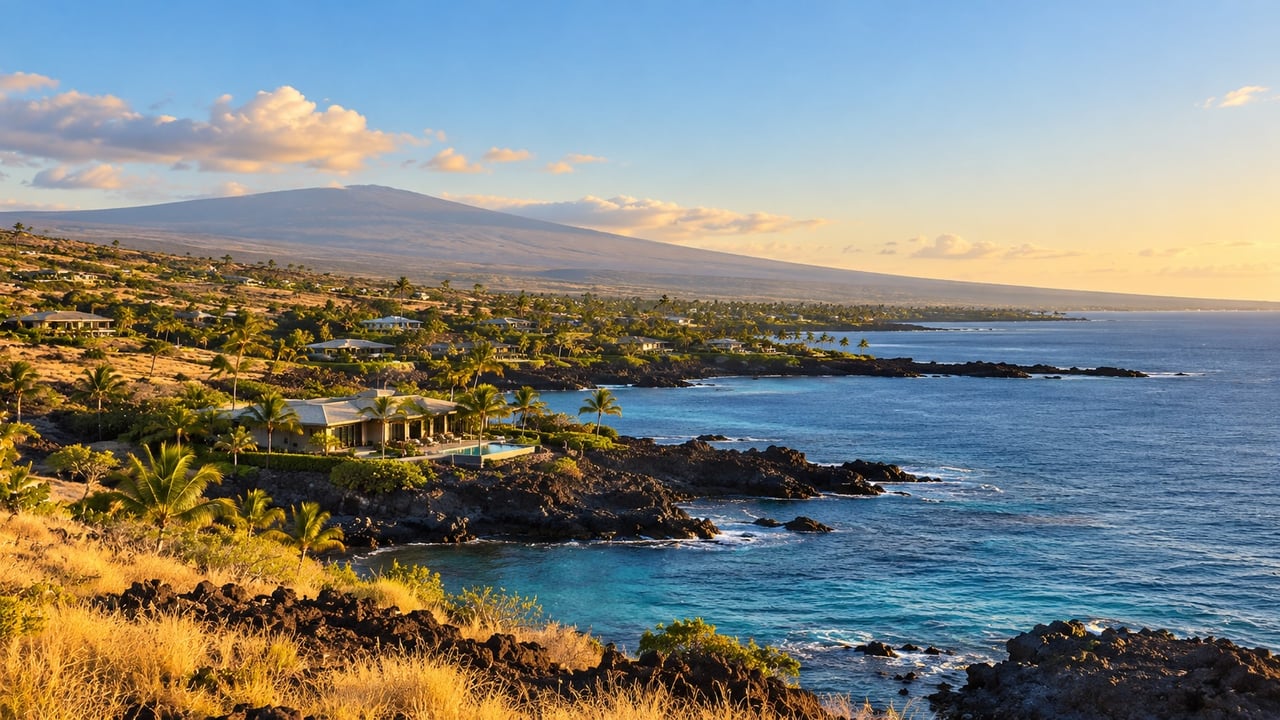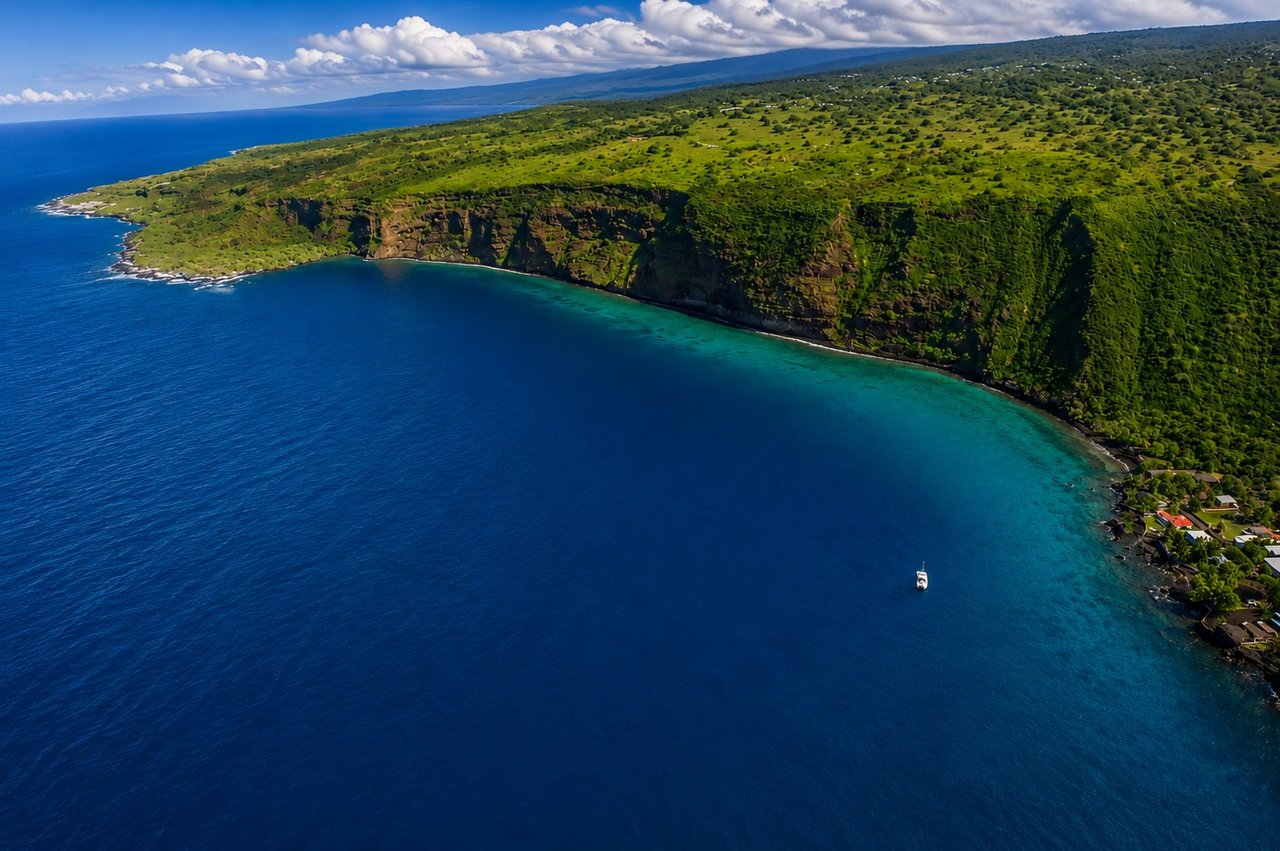
I hike down to Kealakekua Bay about once a month. Two miles down, snorkel for a while, two miles back up. I go early, before the tour boats arrive from Keauhou, or late in the afternoon when the trade winds cool the climb back out. I've been doing this long enough that the trail feels like a commute. But the bay never feels routine.
Part of that is the water. Ka'awaloa Cove on the north shore has some of the healthiest coral reef left on this coast, and the fish life in a Marine Life Conservation District that has been protected since 1969 shows you what Kona's coastline once looked like across its entire length. Part of it is the spinner dolphins that rest in the shallow sandy areas of the bay, present often enough that you learn not to take them for granted and present always on their own terms, not yours.
But mostly it's the weight of the place itself. You feel it the moment you come down off the trail and the bay opens up in front of you. Kealakekua has been central to Hawaiian life for over a thousand years. You are not visiting a scenic attraction. You are standing in one of the most historically and culturally significant places in the Hawaiian Islands, and the experience of being there is completely different once you understand that.
Key Takeaways
- Kealakekua Bay has been a center of life on the island for over 1,000 years. The 180 acres surrounding the bay were designated a state historical park in 1967 and listed on the National Register of Historic Places in 1973.
- Hikiau Heiau at Napo'opo'o is a sacred site. Visitors are asked not to go onto the heiau.
- Kapu signs mark culturally sensitive areas. Do not cross them, and do not move or remove rocks anywhere in the park.
- Kealakekua Bay has been a Marine Life Conservation District since 1969. No taking of fish or marine resources. Stay at least 50 yards from the spinner dolphins.
- Ka'awaloa Cove on the north shore is one of the finest snorkeling sites in Hawaii, best experienced early morning or late afternoon before or after the tour boats arrive.
- The Ka'awaloa trail is two miles each way and steep. Go early or late, and bring more water than you think you need.
Pathway of the Gods
Kealakekua translates as "pathway of the gods." That is not a marketing phrase. It is a description of what this place meant, and still means, to the Hawaiians.
The bay was settled more than a thousand years ago. Early Hawaiians found a safe anchorage with an abundance of marine resources, began clearing the forests, and constructed the extensive upland field system of Kona, cultivating kalo and 'uala, taro and sweet potato, on the slopes above the water. As Hawaiian society developed through the 1600s, the ali'i and kahuna established Kealakekua as one of the chiefly centers of Kona. The commoners, the maka'ainana, farmed the land and fished the bay that supported them all.
Ka'awaloa, on the north shore where the trail comes down, was where the chiefs lived. Between Ka'awaloa and Napo'opo'o stands Pali Kapu o Keoua, a 600-foot volcanic sea cliff named for the chief Keoua. The pali was kapu, off-limits, designated as a sacred burial area. Rock-lined trails connected Kealakekua to neighboring settlements across the island.
At the base of the cliff stands Hikiau Heiau, a massive stacked-rock platform that served as a luakini, a temple of state. As a luakini it was associated with the war god Ku, but it was also the center of the annual Makahiki ceremonies that honored Lono, the god of agriculture. The heiau has been damaged by tsunamis and high surf over the centuries and restored several times. It remains sacred to the Hawaiian people today. Visitors are asked not to go onto the heiau. That request is not a suggestion.
When Cook Arrived
Captain James Cook sailed into Kealakekua Bay on January 17, 1779. His own crew described being surrounded by a multitude of canoes, the entire shore covered with people, hundreds swimming around the ships. They estimated 2,000 people were living along the three miles of shoreline. Cook had arrived during the Makahiki season, a time of peace and gathering, and was met by Kalani'opu'u, the ali'i nui who ruled the island. The young Kamehameha was there, residing at Ka'awaloa.
Cook spent a month in the bay, documenting Hawaiian culture in journals and artwork that remain among the most detailed written records of Hawaiian life at the moment of Western contact. Then a broken mast brought him back a second time. Misunderstandings developed between the Hawaiians and the Europeans. Cook died at Ka'awaloa on February 14, 1779. His body was taken to Puhina O Lono Heiau on the slope above Ka'awaloa. The obelisk monument on the north shore, built in 1874, marks the place where he fell.
I swim past that monument sometimes, on the days I cross from Manini Beach on the south side to the north shore and back. It is an open-water swim across an exposed bay and not something I'd point everyone toward. But there is something about making that crossing that puts the scale of the bay and its history into the body rather than just the mind.
What Respect Actually Looks Like Here
The State of Hawaii and the Division of State Parks have posted kapu signs throughout the area. When you see one, stop. Do not proceed into culturally sensitive areas and do not move or remove rocks. What looks like a loose stone on the shoreline may be part of an archaeological site that has been in place for centuries. It is part of Hawaii's past. Leave it where it is.
The Marine Life Conservation District rules are equally straightforward. No taking of fish or marine resources. Stay at least 50 yards from the spinner dolphins and do not approach, chase, feed, or interact with them. The dolphins come into the bay to rest. That is a biological need, not a show.
These rules exist because this place has been diminished enough already. The population at Kealakekua declined dramatically through the 1800s. The traditional fishing and farming economy gave way to ranching and coffee. The wharf at Napo'opo'o, built in 1894, brought a different kind of commerce. What the MLCD designation in 1969 and the historical park designation in 1967 did was stop the erosion. The reef recovered. The fish came back. The history was acknowledged and protected.
Coming here with that understanding does not make the snorkeling less beautiful. It makes it more meaningful.
Getting There
The Ka'awaloa trail starts at the intersection of Mamalahoa Highway and Napo'opo'o Road in Captain Cook. It is two miles down and two miles back up on a steep, exposed path. Go early morning or late afternoon. Bring more water than you think you need. The south shore is accessible from Manini Beach at Napo'opo'o, where storm surf has transformed what was once a sand beach into a boulder shoreline.
Boat tours and kayak rentals run out of Keauhou and Honokohau Harbor if the hike is not for you. Either way, read the State Parks brochure for Kealakekua Bay before you go. It takes ten minutes and it will change how you experience the bay.
For more on the Kona coast's best snorkeling spots, see our snorkeling guide. And if being this close to South Kona has you thinking about what it might be like to live here, feel free to reach out.
Frequently Asked Questions
Why is Kealakekua Bay considered historically significant?
Kealakekua, which means "pathway of the gods," has been a central place in Hawaiian cultural and political life for over a thousand years. It was one of the chiefly centers of Kona, home to the ali'i at Ka'awaloa and the site of Hikiau Heiau, a major ceremonial platform. Captain Cook arrived here in January 1779 and died here the following month. The bay and surrounding 180 acres were designated a state historical park in 1967 and placed on the National Register of Historic Places in 1973.
What is Hikiau Heiau and can visitors go onto it?
Hikiau Heiau is a large stacked-rock platform at Napo'opo'o, built as a luakini, or temple of state. As a luakini it was associated with the war god Ku, and it was also central to the annual Makahiki ceremonies honoring Lono. It has been damaged by tsunamis and restored several times over the centuries. It remains sacred to the Hawaiian people today. Visitors are asked not to go onto the heiau, and that request deserves full respect.
What are the rules at Kealakekua Bay?
Kealakekua Bay is a Marine Life Conservation District. Taking fish or marine resources is prohibited. Spinner dolphins must be given a minimum 50-yard berth and may not be approached, chased, fed, or disturbed. Kapu signs mark culturally sensitive areas where visitors should not proceed. Rocks should never be moved or removed, as they may be part of an archaeological site.
Is Kealakekua Bay good for snorkeling?
Ka'awaloa Cove on the north shore is consistently among the best snorkeling locations in Kona. The coral reef is healthy and comes directly to the pahoehoe shoreline. The fish diversity and density reflect decades of Marine Life Conservation District protection. Early morning, before the tour boats arrive, is the best time to be in the water.
How do I get to Ka'awaloa Cove?
By trail, the Ka'awaloa Road starts at the intersection of Mamalahoa Highway and Napo'opo'o Road in Captain Cook and drops two miles to the north shore. It is steep and exposed. Go early or late afternoon. Several boat tour and kayak rental operators run trips to the cove from Keauhou and Honokohau Harbor. The south side of the bay is accessible from Manini Beach at Napo'opo'o.
Can I swim with the dolphins at Kealakekua Bay?
No. Federal and state rules prohibit approaching, chasing, feeding, or interacting with spinner dolphins. They use the bay to rest, which is a genuine biological need. The minimum required distance is 50 yards. The dolphins are often visible while snorkeling or swimming in the bay, and watching them from a respectful distance is the right way to experience them.
Source: State of Hawaii, Department of Land and Natural Resources, Kealakekua Bay State Historical Park & Marine Life Conservation District.
Mark Davis, Esq. is a licensed real estate broker and partner at Kona Homes for Sale with Brenda Kuessner at Coldwell Banker Island Properties. He has lived on the Big Island full time for five years and hikes down to Kealakekua Bay about once a month, which he considers a reasonable use of his time.